Engineering Mentoring Network
Join NC State faculty to share tools, address common challenges, and improve student autonomy through four core principles.
Sailing through Mentorship
You want students who can navigate open waters that move projects forward, making sound decisions, and coming to you with a clear heading rather than asking, “What should I do next?” Mentoring helps them set that course, but taking the helm takes time and practice.
The Engineering Mentoring Network gives faculty a collaborative harbor to share what works, address common headwinds, and test small, high-impact adjustments in their mentoring practice. Each session offers engineering/STEM-specific examples, practical navigational tools, and dedicated time to compare approaches with colleagues.
Who should participate?
Faculty who mentor undergraduate and graduate researchers, teaching assistants, graduate assistants, and postdocs. All NC State faculty are welcome, with examples and tools focused on engineering and other STEM settings.
What to expect
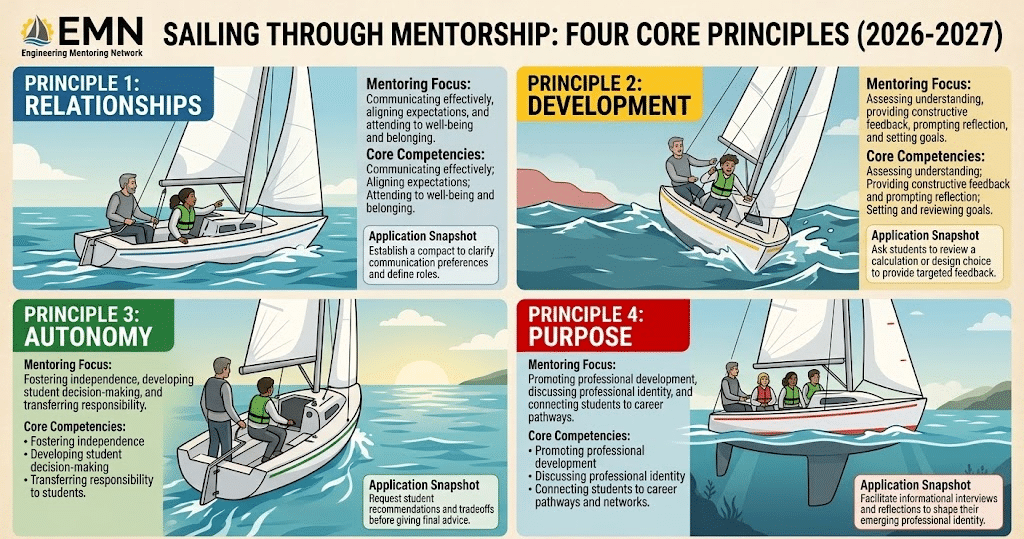
The 2026-2027 pilot includes a kickoff and four lunch and learns organized around Relationships, Development, Autonomy, and Purpose. Participants will explore practices such as clarifying responsibilities, giving constructive feedback, and helping students take greater ownership of their work.
As AI rapidly changes the landscape of engineering practice, students still need opportunities to explain their reasoning, learn from constructive feedback, and collaborate effectively as part of a crew. We’ll explore how mentoring conversations, engineering journals, and e-portfolios can help students chart their progress, sharpen their judgment, and demonstrate these essential skills as they prepare for research, teaching, or industry.
Each lunch and learn brings together a short talk from a guest faculty speaker, peer discussion to tackle common headwinds, selected literature and tools, and dedicated time to adapt one practice to keep your own mentoring on course to be used immediately.
Kickoff: Mentoring: Critical Now More Than Ever
Wednesday, September 30, 2026 | 12:00–1:00 p.m.
Fitts-Woolard Hall, Room 3301
Dr. Joel Ducoste will share his perspective on what mentors and students can learn from one another and how curiosity, constructive feedback, and judgment support students’ growth. We’ll introduce the Network’s four principles and hear what participants would like to explore during the pilot.
Lunch will be provided. Please submit your Neomonde lunch order, including any allergies or dietary needs, by Tuesday, September 29, at 5:00 p.m.
EMN Schedule
All sessions meet from 12:00-1:00 p.m. in Fitts-Woolard Hall, Room 3301.
Relationships | Reading the Environment
November 16, 2026
Establish a mentoring compact to clarify expectations, communication channels, and check-in habits
Competencies addressed:
- Communicating effectively
- Aligning expectations
- Attending to well-being and belonging
Development | Navigating Resistance
February 5, 2027
Assess what students know, use feedback and reflection to support learning, and help students set and review goals.
Competencies addressed:
- Assessing understanding
- Providing constructive feedback and prompting reflection
- Setting and reviewing goals
Autonomy | Delivering Lift, Not Drag
March 12, 2027
Adjust support so students take increasing responsibility for their thinking, decisions, and work.
Competencies addressed:
- Fostering independence
- Developing student decision-making
- Transferring responsibility to students
Purpose | Shared Quest & Character
April 2, 2027
Help students connect their experiences to career possibilities, professional communities, and their developing identities.
Competencies addressed:
- Promoting professional development
- Discussing professional identity
- Connecting students to career pathways and networks
Putting mentoring into practice
Participants leave each session with one practice or tool to try with a student and discuss at the next meeting. The pilot curriculum draws on the National Academies’ Science of Effective Mentorship in STEMM, CIMER curriculum, the Mentoring Competency Assessment, and NC State’s earlier EngEx Mentor Network.
Questions? Contact Megan Morin in the Engineering Office of Faculty Development and Success.