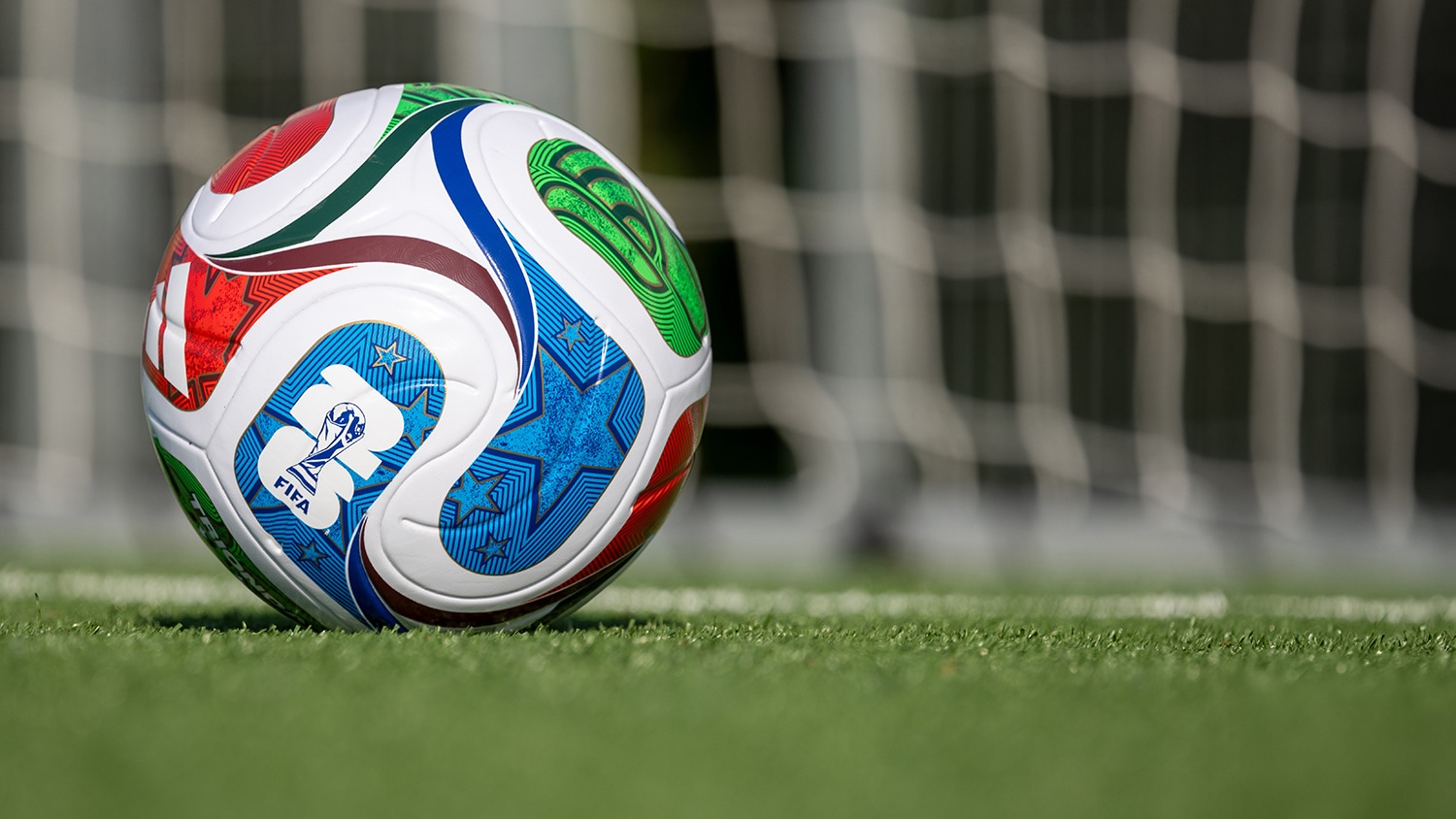
Whether you’ve followed every FIFA World Cup game so far this summer or only caught the highlights, you’ve seen NC State Engineering at play.
Researchers with NC State University’s Constructed Facilities Laboratory (CFL) aren’t scoring goals, but they did provide a critical assist to all World Cup soccer players by helping to improve their playing fields across North America.
“A critical aspect of the engineering testing and research we perform at the CFL is to support the implementation of positive laboratory results in real world practice” said Gregory Lucier, a research professor in the Department of Civil, Construction and Environmental Engineering and manager of the CFL. “It is especially exciting to see the results of our work contributing on such a visible stage.”
The CFL was a testing site for elements of the hybrid natural grass and artificial turf system deployed to the World Cup host sites. This system ensures all playing fields have similar natural grass surfaces to meet FIFA requirements.
Developed over the last several years by an international team of researchers, this system combines natural grass and artificial turf. It’s layered on top of a material called Permavoid, which is manufactured by ABT Inc. in Statesville, North Carolina. The modular, interlocking, permeable plastic material is often used in stormwater management projects.
“Our portion of the project was to test Permavoid for ABT to confirm its structural load capacity both for the players and for the equipment used to construct and maintain the fields,” Lucier said.
Half of the 16 North American stadiums hosting matches normally use artificial turf, an unpopular playing surface for professional soccer players. Artificial turf is typically a harder playing surface than natural grass, which can cause the ball to roll differently and make it more difficult for players to turn and move quickly. But in many of the World Cup host stadiums, a natural grass field is impractical due to a closed roof or environmental conditions incompatible with grass. Previous attempts to lay sod directly on top of the artificial turf led to poor playing conditions.
With the new hybrid system, natural grass is grown on synthetic mats with root layers reinforced by synthetic fibers. These mats of reinforced natural grass are easy to roll and move — making it easy to quickly put down a professional-caliber soccer pitch — but they must be installed on a stable structural base to create a suitable playing surface. Laying the mats over Permavoid supports the grass while allowing for irrigation and root growth.
The hybrid system also helps the playing surface stay cool. One of the reasons FIFA requires natural playing surfaces over artificial turf is that the latter can become too hot.
Natural grass cools the playing surface when it moves water out of the ground and into the surrounding atmosphere through a process called evapotranspiration. Permavoid enables this process for the synthetic mats of natural grass by maintaining a reservoir of water under the field, accessible to the roots. This mechanism also works when artificial turf is installed over Permavoid with an absorbent underlayment. Water is wicked up to the artificial turf where it evaporates, cooling the playing surface.
“In addition to structural testing, we used our large environmental chamber to study the evaporative cooling effect in combination with different natural and artificial grass surfaces,” Lucier said.
When paired with Permavoid and a water reservoir, the CFL team found that the natural grass surface and a fully artificial turf surface both maintained cooler playing temperatures than did natural grass grown in traditional soil.
“These preliminary tests go beyond the World Cup. They offer a path to cooling thousands of high school and college synthetic fields that are at times unusable due to the heat,” said Tom Simon, director of sales and marketing for ABT and SportsEdge. “We routinely rely on Dr. Lucier and his team at the NC State Constructed Facilities Laboratory to deliver rigorous independent testing to validate our products for the highest levels of performance.”


