WeRide Donates Autonomous Driving Platform
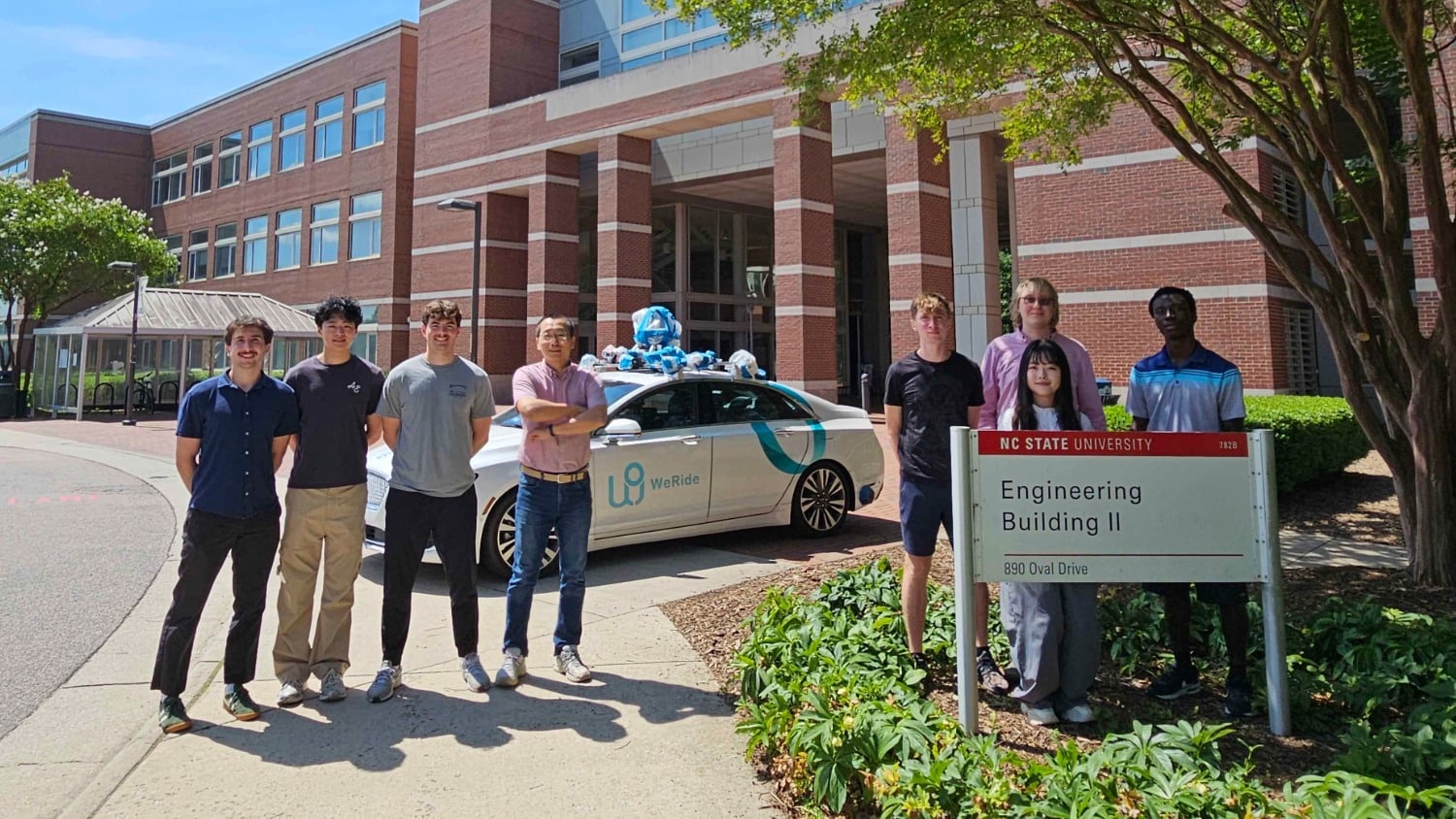
The North Carolina State University Department of Computer Science (CS) recently received a donation of an autonomous driving research platform from WeRide Inc., a global autonomous driving technology company. The donated platform, a Lincoln MKZ equipped with multiple sensors and onboard computing units, will support research and education in autonomous systems, cyber-physical systems, real-time computing and intelligent transportation. The vehicle will be housed within the Real-Time and Intelligent Systems (RTIS) group, led by CS Associate Professor Zhishan Guo. This donation will provide students and researchers with a hands-on platform for studying the computing challenges behind safe, reliable and responsive autonomous systems.
For Guo and his students, the platform creates new opportunities to connect theory with practice. Autonomous driving systems require tight integration of sensing, perception, decision-making, control and real-time computing. They must also operate under strict timing, safety and resource constraints. Having access to a full vehicle platform will allow the group to explore these challenges in a realistic system setting — from sensor data processing and embedded computation to scheduling, verification and system-level design.
“This platform gives our students a rare opportunity to work with a real autonomous driving system, not just simulations or small-scale prototypes,” said Guo. “It will help us study how intelligent algorithms, real-time systems and cyber-physical infrastructure come together in safety-critical applications.”
The donation also strengthens the department’s growing emphasis on cyber-physical systems. Guo serves as the lead of NC State’s recently established Cyber Physical Systems (CPS) group, which brings together faculty and students working at the intersection of computing and the physical world. The team’s research spans a variety of fields, including: transportation and autonomous driving systems, robotics, personalized healthcare and medical sensing-control systems, agricultural systems, embedded and real-time systems, machine learning, sensing, networking and intelligent infrastructure.

The WeRide platform will help expand the CPS group’s ability to support student training, collaborative research and external partnerships. Students in the RTIS group, as well as those working on related CPS research projects, will be able to engage directly with the hardware, software and system integration challenges that define modern autonomous technologies.
With the new platform, NC State engineering and computer science students will gain expanded opportunities to study autonomous driving as a real-world cyber-physical system — one that brings together algorithms, software, hardware, sensing, control and human-centered safety in a single, highly complex environment.
This post was originally published in the Department of Computer Science.
- Categories:


