Wading into Energy Conversion
Students study ocean systems with the Dean’s Research Fund
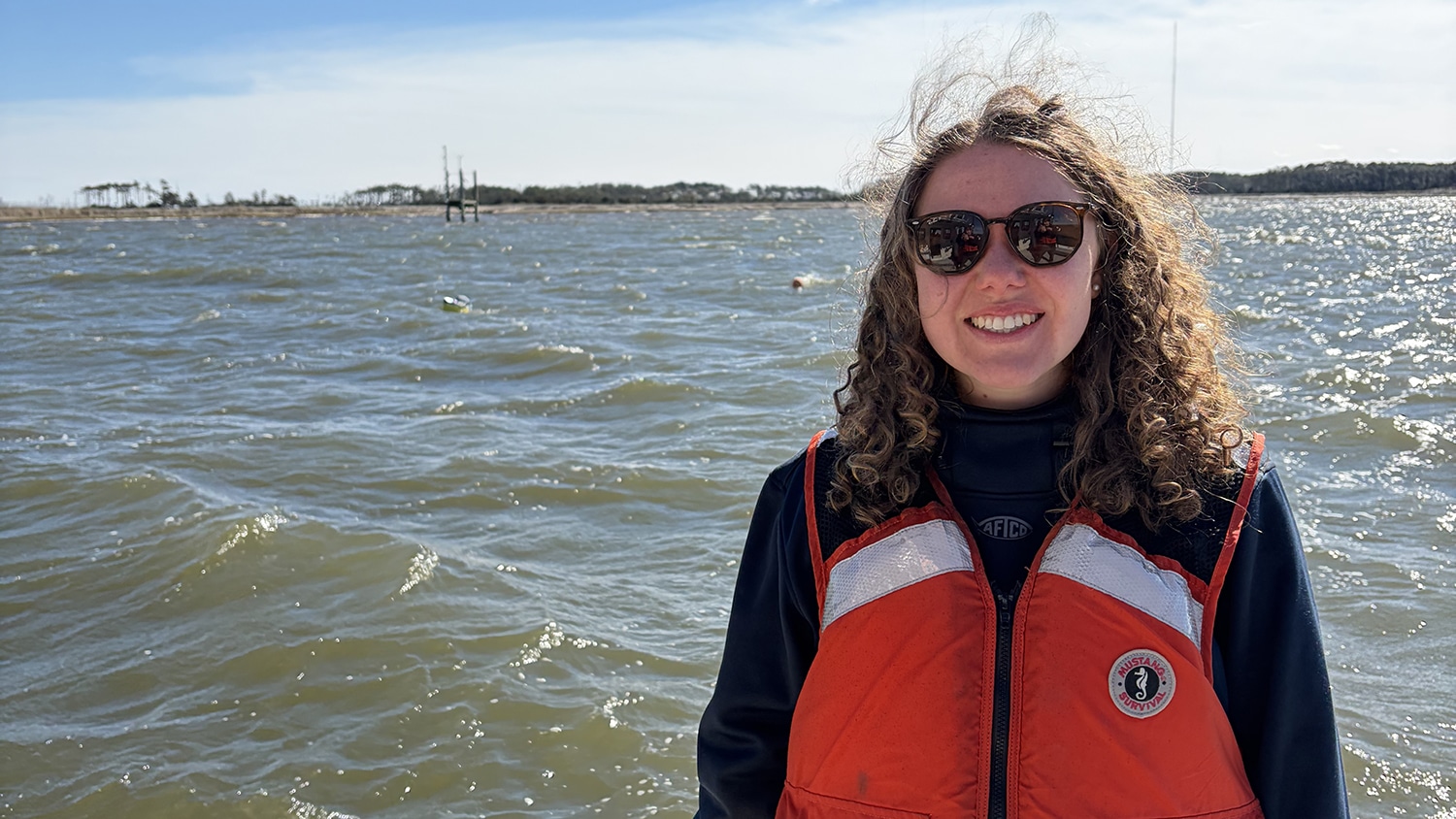
Allison File is converting ocean waves into energy.
File, a second-year Ph.D. student at NC State, works in the Intelligent Systems and Structures Research Lab, where she’s conducting new research innovating wave energy converters. The lab is led by Matthew Bryant, a professor in the Department of Mechanical and Aerospace Engineering.
“We’re developing a control algorithm that can sense the waves, see what the conditions are and tune itself accordingly,” said File. “We developed a small scale prototype and tested it at the coast last March, and that was really successful. It produced a little bit of power and charged a battery.”
File’s research is partially funded by the Dean’s Leadership Fund, which partially supports grad fellowships across the college. She is also a National Science Foundation Graduate Research Fellow and a Goodnight Doctoral Fellow.
We spoke with File about her research, her time at NC State and the importance of the Dean’s Leadership Fund for her innovative research.


Talk to me about your research. What are you working on?
We’re developing a wave energy converter. So, for explanation, that’s a buoy that sits on the surface of the ocean and is anchored to the ocean floor, and it uses the movement of the wave motion to generate energy. That could be used to bring a cable back onshore, power coastal communities or, at smaller scales, power oceanographic buoys.
What are you doing with your research that’s new or different?
A lot of these devices have very low efficiency because they’re designed for certain wave conditions. Whenever those waves are outside of that resonance, you’re going to have very low efficiency and power production. That makes it really hard to commercialize. What we’re looking at is creating a device that’s able to tune itself, so it can align with whatever the incoming wave condition is.
Your research is supported by the College of Engineering’s Dean’s Leadership Fund. What is that money going toward?
Besides for my stipend, it goes toward different materials. We’re 3D printing our third buoy. We pay for a lot of the time that goes into developing the controller and researching different existing methods. We can take the time to work towards new ideas and how to approach this.
What made you pick NC State for your research?
I was at the University of North Carolina at Charlotte for undergrad, and then I came to NC State because I want to work with Dr. Bryant on marine energy. When I toured, I was really impressed by how many resources are at NC State and by the community that was here, both in my lab group that I met and in the overall like mechanical engineering department.

Why should the average person care about your project?
Just looking at the wave energy available around the United States alone, this energy source could power over 130 million homes. There’s a lot of capacity there, but we’re just not using it right now because we can’t get these devices to survive, and we can’t get them to have high efficiencies. This is a really huge untapped resource that we really haven’t quite figured out yet, and it would, I think, do a lot of good.


