Accessibility At the Forefront
At the College of Engineering's first Accessibility in STEM Conference, attendees from industry, academia and more came together to discuss access in engineering.
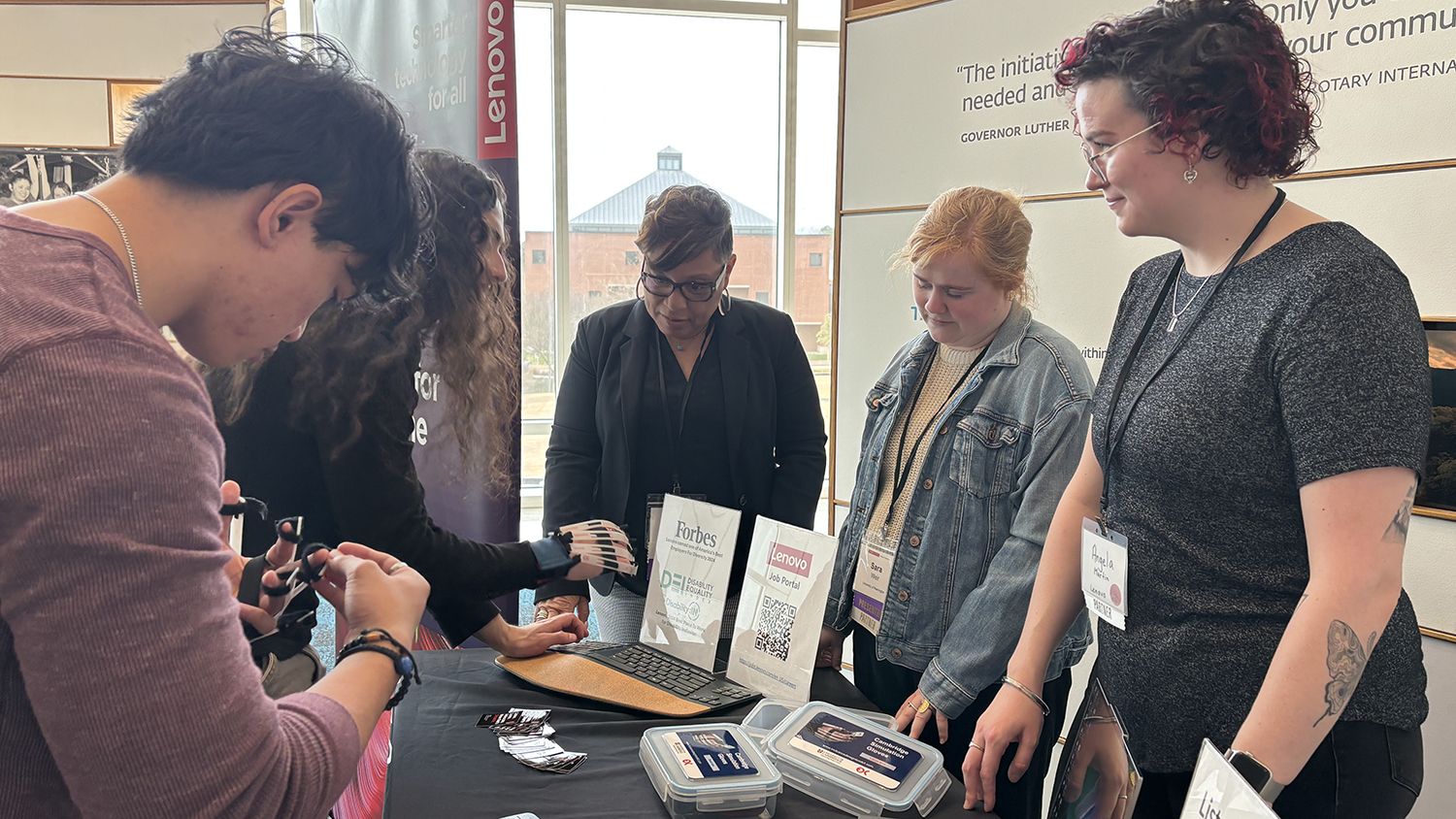
NC State University’s College of Engineering hosted its first conference on accessibility in January. The Accessibility in STEM Conference brought together educators, students, employers and innovators to discuss how to ensure science, technology, engineering and mathematics (STEM) is for everyone.
The conference, which ran from Jan. 6-8 in the James B. Hunt Jr. Library on Centennial Campus, included American Sign Language interpreters, braille programs, toys for stimming, pens with grips designed for users who can’t fully close their hands and more.

“We know that access needs are not always visible, and they are not the same for everyone,” said Angelitha Daniel, assistant dean of the Office for Wellbeing and Engagement (OWE). “Our goal has been to create a conference where participants can engage in ways that work best for them, without having to ask or explain.”
Domonique Carter, university program manager with OWE, came up with the idea for the conference after attending multiple STEM events where accessibility seemed to be an afterthought.
“I knew we needed a space that centered accessibility as essential to innovation, not supplemental to it,” she said. “When I returned from my final conference of the academic year, I shared this vision with Assistant Dean Daniel, and from that moment forward, we committed to creating something different.”

The conference was intentionally designed to highlight the groundbreaking work already happening across the country while also centering the lived experiences and success stories of people with disabilities in STEM.
“The overwhelming response, from the number of proposals submitted by presenters nationwide to the generosity of our sponsors and partners, confirmed what we suspected,” she said. “There are very few convenings, if any, that are solely dedicated to accessibility in STEM in this way. This conference filled a gap that people have been waiting for, and its success affirmed that this work is both necessary and long overdue.”
Jim Pfaendtner, the Louis Martin-Vega Dean at the College of Engineering, counts accessibility as a core priority.
“Accessibility is important to me as an academic leader, as a professor, as a practitioner and as a chemical engineer,” said Pfaendtner in his remarks at the conference. “I know when we reduce barriers to access for engineering and computer science students, we boost success and innovation for everyone.”
Access in all STEM spaces
In her keynote address, Monique Johnson, a disabled artist and activist, pointed to the numbers to show how difficult it is for disabled people to break into STEM fields.
While a quarter of the adult population in the U.S. lives with a disability, they represent only 10% of the STEM workforce and 3% of leadership roles in STEM, based on a 2023 study from ACS Professional Staffing. Fewer than 2% of STEM patents list a disabled inventor.
“Companies that prioritize inclusive design, they outperform their peers by 30%,” said Johnson. “Workplace accommodations for employees with disabilities are not often expensive. Nearly half don’t cost a thing.”

Johnson started the keynote with the story of her birth, including how the doctors who delivered her didn’t believe she would live into adulthood. At the age of 39, she advocates for access in all spaces.
“Disability is the largest minority group in the world, and it’s the only one that anyone can join at any time through age, illness, accident or circumstance,” she said.
Johnson emphasized that disabled engineers are often excluded due to systems that fail to accommodate a wide variety of abilities.
“So what does meaningful inclusion look like?” she asked. “It looks like disabled students in engineering labs, not just in disability offices. It looks like disabled professionals in product testing and leadership. It looks like disabled voices shaping policy, design and research priorities. It looks like technology for everyone.”
Disability in academia and other panels
Students and industry leaders from around the country led panels and breakout sessions about disability in STEM.
Others focused on specific diagnoses, such as advocacy for people with autism and other neurodivergent diagnoses in engineering and supporting Deaf students.

In one panel on disability in higher education, Rachel Figard, an assistant professor at the University of Georgia’s College of Engineering, spoke about her lived experiences with disability in academia. Figard is part of the university’s Engineering Education Transformations Institute and the School of Environmental, Civil, Agricultural, and Mechanical Engineering,
Figard earned her bachelor’s degree in industrial and systems engineering from NC State. When she started at the College of Engineering, she recalls wanting to experience the same things as her able-bodied peers. Figard didn’t seek disability accommodations her junior year, and only because she was struggling during tests and missing classes.
“The phrase ‘disability does not define me’ is something that I’ve never related to,” she said. “For the majority of my life, it has defined the way I think, make decisions, navigate the educational system and lead my life.”
Designing accommodations for all
In between discussions and networking events, attendees had time to learn more about research and local resources in the Triangle, and to try out accessible technology.

A group from Lenovo brought gloves that simulated the feeling of arthritis and glasses that temporarily alter the cones in the wearer’s eyes, mimicking colorblindness. Tadpole, a group from Duke University dedicated to creating adaptable children’s toys, brought a cow and a lion for attendees to play with. The stuffed animals have buttons outside of their bodies that children can more easily press to make noises.
Outside, the fun continued on wheels.
Wes Hall, cofounder and CEO of North Carolina Adapted Sports, ran an interactive display where attendees could ride one of his adaptable bikes. Hall is an amputee who had part of his right leg removed due to osteosarcoma, a type of bone cancer, as a teenager.
With adaptable hand grips, seats and brakes, the bikes adjust to the user, including those who have dynamic disabilities and different needs depending on the day.

“With the modification, with the hand grips, it can work for non-paralyzed hands and paralyzed hands,” he said. “If someone was quadriplegic and it was set up for them, within about 10, 20 minutes, we could reverse it for someone who has a strong grip.”
What’s next?
Staff and volunteers from OWE hope attendees left the conference with a renewed passion for accessibility.
“It’s important to have accessibility within all areas of careers, especially with how much technology is advancing,” said Angelina Nguyen, a conference volunteer and first-year biomedical engineering student.
“But there’s also more research and work needed so every person’s needs are met, especially in underfunded communities, where people don’t have the same access to resources,” she added. “We’re very privileged, and also there should be more effort in all areas around the country to make sure that everyone has what they need.”

Daniel and her team are reflecting on this year’s successes — and already thinking about next year’s conference.
“It was rewarding to see the product of months of careful planning come together with a successful outcome,” said Daniel. “It was great to see educators, researchers and advocates convene around a shared commitment to advancing accessibility in STEM.”
Daniel, the OWE team and COE faculty and staff are using the conference’s success as a base for their continued work to make STEM more accessible at the College of Engineering.
“Our unit remains committed to providing ongoing opportunities for the College of Engineering community to ensure all individuals can fully participate in STEM,” she said. “Accessibility is foundational to innovation and excellence.”
- Categories:


